It has the Main Buddha Hall and the Hall of Arhats, both designated Treasures. The foundation stones of the Main Buddha Hall are carved with sea creatures such as turtles and crabs. The temple is always open with no closing days, there is no admission fee, and parking is available.
Source: Korea Tourism Organization · KOGL Type 1 · 6 photos
Mihwangsa Temple Today
Worked out per date
Nov 4 (Wed)
Open at all times
Sources: Hours and closed days: Korea Tourism Organization
Mihwangsa Temple: a temple that declined after a shipwreck and was rebuilt from 1989
It once had 12 hermitages, but it gradually declined after monks who set out on a journey for its rebuilding were shipwrecked at sea 100 years ago. The temple stood empty for a long time and came back to life in 1989, when the monks Jiun, Hyeongong and Geumgang arrived. After more than 10 years of rebuilding, the Hall of the Underworld, the Main Buddha Hall, the Hall of Arhats and other halls were restored. source 1
Mihwangsa Temple: a stupa field carved with child monks and goblin faces
About a 10-minute walk along a forest path from the temple is a stupa field. Its stupas are carved with simple figures such as child monks and goblin faces. It also appears in a drama as the temple Park Ha-gyeong visits for a temple stay. source 1
Mihwangsa Temple: Scenic Site No. 59, where Buddha, rocks, and sunset come together
The 'Three Yellows (三黃)' said of Dalmasan Mountain refer to how the Buddha statue, the rocks and the sunset light come together. Mihwangsa Temple stands with a folding screen of rocks behind it, facing the West Sea. The 'Haenam Dalmasan Mountain and Mihwangsa Temple Area' of 4,619,039 m², including the temple, became Scenic Site No. 59 on September 18, 2009. Layers of weather-resistant quartzite are exposed on the ridge, so white rocky peaks line up like a folding screen. source 2


 Dalmagodo Trailstraight-line 170 m
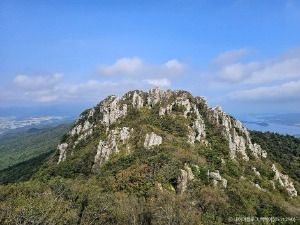 Dalmasan Mountainstraight-line 170 m

