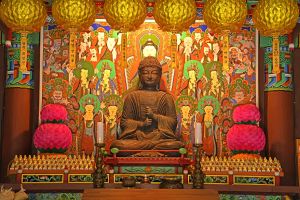
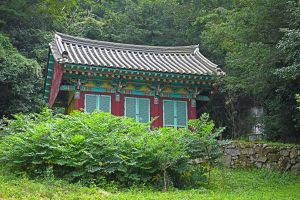
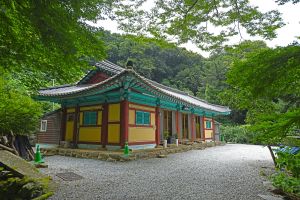
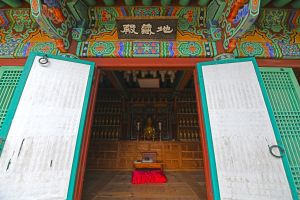
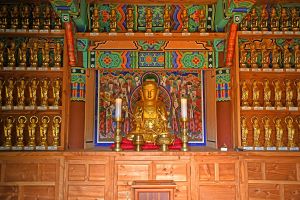
Its Medicine Buddha Hall enshrines an iron Vairocana Buddha statue thought to date from the early Goryeo period. Its evening bell, called the 'Evening Bell of Eunjeoksa', has long been counted among the Eight Views of Haenam. It is always open with no closing days, there is no admission fee, and parking is available.
Source: Korea Tourism Organization · KOGL Type 3 (no changes allowed) · 6 photos
6 photos ↓ · Source: Korea Tourism Organization · KOGL Type 3 (no changes allowed)
Eunjeoksa Temple Today
Worked out per date
Nov 4 (Wed)
Open at all times
Sources: Hours and closed days: Korea Tourism Organization
How do Haenam's temples, Daeheungsa Temple, Mihwangsa Temple, and Dosoram Hermitage, differ?
Eunjeoksa Temple in detail
Eunjeoksa Temple: a history continuing from a hermitage of the old Dabosa Temple
This site originally had a temple called Dabosa and its hermitage, Eunjeogam. After Dabosa fell into ruin in the mid-19th century, the name became Eunjeoksa Temple. The temple holds that it was first built as Dabosa in the 21st year of King Jinheung of Silla (560). Judging from when the iron Buddha was made, it believes the temple existed by the early Goryeo period at the latest. During the Imjin War, everything burned down except the Hall of Arhats. In 1648 the temple was revived with a large stone pagoda and new buildings.
Eunjeoksa Temple: the Iron Seated Vairocana Buddha and the Gongsepo Buddha legend
The Iron Seated Vairocana Buddha, Provincial Tangible Cultural Heritage No. 86, is broken at the lower body and knees. It is thought to have been made around the 10th century. Its robe folds closely resemble those of the iron Buddhas of Dopiansa Temple in Cheorwon and Borimsa Temple in Jangheung. A legend says a Buddha statue that appeared at Gongsepo in Sanmang-ri would not budge for anyone else but was lifted when a monk of Eunjeoksa Temple came. It is now enshrined in the newly built Vairocana Hall.
Eunjeoksa Temple: the three-story stone pagoda in front of the Medicine Buddha Hall, moved from Namgye Village
The three-story stone pagoda in the front yard of the Medicine Buddha Hall once stood at a private home in Namgye Village, Jangchon-ri, Masan-myeon, below the temple. It was moved and rebuilt here in 1996. It is about 2.2 m tall, its finial parts no longer remain, and it is seen as a pagoda from the mid-Goryeo period or later.